
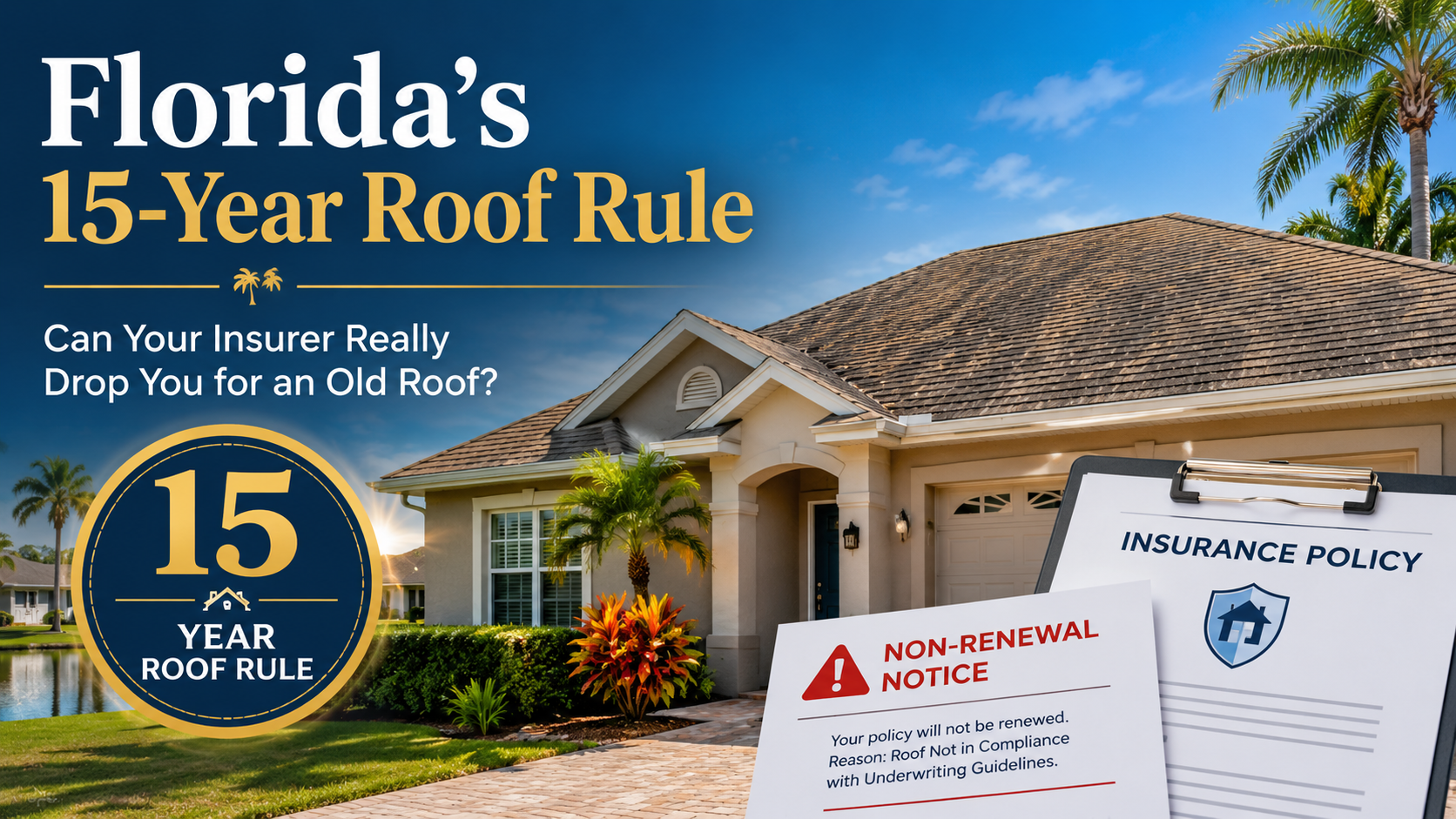
If you own a home in Central Florida and your roof is creeping past the 15-year mark, there’s a good chance one of these has already happened — or soon will:
- A letter from your insurance company saying your roof is now “aged” and requires an inspection.
- A non-renewal notice that lists roof age as the reason.
- A neighbor telling you their carrier dropped them, and now you’re wondering if you’re next.
Here’s the good news: an old roof, by itself, is not a legal reason for your insurer to drop you. Florida law gives you specific rights — and a clear path to keeping your coverage even if your roof isn’t brand new. The catch is that the burden is on you to prove your roof is still in good shape, and most homeowners don’t find out how until it’s already a crisis.
This guide walks through exactly what the law says, how “roof age” is actually calculated, and the single most effective step you can take before your carrier forces the issue.
The short version
- Insurers cannot refuse to issue or renew your policy solely because of roof age if your roof is under 15 years old.
- For roofs 15 years or older, your insurer must let you get an inspection before requiring a replacement as a condition of coverage.
- If a qualified inspection shows your roof has 5 or more years of useful life remaining, the insurer cannot drop you based on age alone.
- As of July 2024, licensed roofing contractors are recognized as authorized inspectors for this purpose.
- The smartest move is to get inspected before you receive a demand letter — on your terms, not the insurer’s clock.
What Florida’s roof-age law actually says
The rule most people call the “15-year roof rule” comes from Florida Statute §627.7011. It isn’t a building code — it’s an insurance law, and it was written specifically to stop carriers from cancelling perfectly sound roofs just because of a number on paper.
The statute lays out two tiers:
Roofs under 15 years old. Your insurer may not refuse to write or renew your homeowners policy solely because of the age of the roof. If you get a non-renewal notice citing roof age on a roof this young, that’s a notice worth questioning.
Roofs 15 years and older. Before an insurer can require you to replace your roof as a condition of coverage, it must allow you to have a roof inspection performed by an authorized inspector at your own expense. And if that inspection shows your roof has 5 years or more of useful life remaining, the insurer cannot refuse to issue or renew your policy based on roof age alone.
In plain terms: once your roof hits 15, the conversation shifts from “how old is it?” to “what condition is it in?” — and condition is something you can document and control.
”Roof age” isn’t always what you think
A lot of homeowners assume their roof’s age is measured from the day the house was built. It isn’t. Under the statute, your roof’s age is based on the last date on which 100% of the roof’s surface was built or replaced in accordance with the building code in effect at that time.
That matters for two reasons:
- If you did a full re-roof ten years ago on a thirty-year-old house, your roof is ten years old for insurance purposes — not thirty.
- Patch repairs and partial replacements generally do not reset the clock. Swapping a few shingles after a storm doesn’t establish a new installation date; only a complete, permitted re-roof does.
Before you accept a carrier’s assumption about your roof’s age, it’s worth pulling your permit records to confirm the date of your last full replacement.
Who is allowed to inspect your roof?
This is where the law recently got more homeowner-friendly. The list of “authorized inspectors” includes home inspectors, engineers, and architects — and, since a 2024 update to the law, licensed roofing contractors as well.
That’s significant. It means the same licensed professional who actually installs and repairs roofs for a living can now produce the documentation your insurer needs. A contractor knows precisely what an underwriter is looking for — flashing condition, granule loss, ridge and hip integrity, deck soundness, evidence of leaks — because they’re the ones who fix those problems.
Orange Contracting and Roofing holds Florida certified general contractor and certified roofing contractor licenses, which is exactly the credential the statute points to.
What a roof condition certificate does for you
When a qualified inspector examines your roof and finds it structurally sound with meaningful life left, the result is a written roof condition certificate (sometimes called a roof health certificate or roof certification). A good one documents:
- The roofing material and system type
- Condition of shingles or panels, flashing, sealants, gutters, ridge caps, and decking
- Any evidence of water intrusion or prior damage
- An estimated remaining useful life — the number the insurer cares about most
This single document is what you send to your carrier to satisfy an inspection requirement or push back on an age-based non-renewal. Instead of arguing about how old your roof is, you’re handing them proof of what condition it’s in.
One honest caveat: a passing certificate is a powerful tool, but it isn’t a magic shield. Some carriers insist on their own network inspectors or have additional underwriting criteria beyond roof age. Always confirm your specific carrier’s requirements, keep copies of every repair and maintenance record, and treat the certificate as the centerpiece of a documentation file — not the only page in it.
Don’t wait for the letter — beat your insurer to it
The homeowners who navigate this well have one thing in common: they got inspected before the demand letter arrived.
Waiting until your carrier sends a “replace-or-be-dropped” notice puts you on their timeline, often with a tight deadline and no room to plan. Getting an independent inspection in advance — ideally around year 13 or 14, or as soon as you know your roof is aging — lets you:
- Catch small issues while they’re still cheap to fix, before they become disqualifiers.
- Build your documentation calmly instead of scrambling.
- Walk into renewal season with proof in hand instead of a panic in your inbox.
Because licensed roofing contractors can now serve as authorized inspectors, that first look doesn’t have to cost you anything. Orange Contracting and Roofing offers a free roof inspection and, where the roof qualifies, a roof condition certificate you can take straight to your carrier. Book yours in a couple of minutes on our contact page.
What if the roof doesn’t pass?
Sometimes an inspection turns up real problems — and it’s better to know now than after a claim is denied. If your roof won’t clear the 5-year threshold, you generally have a few paths, depending on what the inspector finds:
If there’s storm or wind damage. Damage from a covered event may be the basis of an insurance claim, which is a completely different conversation from an age-based non-renewal. If that’s your situation, our sister firm NeJame Claims Adjusting is a licensed public adjusting firm that represents homeowners — not carriers — in getting claims paid fairly.
If it’s simply worn out. A planned, proactive replacement on your own schedule is almost always cheaper and less stressful than an emergency reroof forced by a lender after you’ve lost coverage. And there’s a real upside: a brand-new, code-compliant roof lets you file a wind mitigation inspection, which can earn you insurance premium credits for years. A new roof isn’t just a new roof — it’s often lower premiums, too.
Either way, you’ll know your options before you’re backed into a corner.
Frequently asked questions
Can my insurance really be cancelled just because my roof is old? Not for roofs under 15 years old — age alone isn’t a permitted reason. For roofs 15 and older, a carrier can require replacement unless a qualified inspection shows at least 5 years of remaining useful life.
Who can inspect my roof for insurance purposes in Florida? Home inspectors, engineers, architects, and — as of the 2024 update to the law — licensed roofing and general contractors.
Does replacing a few shingles reset my roof’s age? No. Insurance age is based on the last time 100% of the roof surface was replaced under code. Partial repairs don’t restart the clock.
How much does an insurance roof inspection cost? It varies, but because licensed roofing contractors can now perform them, many homeowners can get a professional inspection at no cost. Orange Contracting and Roofing offers one for free.
What should I do the moment I get a non-renewal notice citing roof age? Don’t ignore it, and don’t assume replacement is your only option. Check your roof’s true age from permit records, and get a professional inspection right away to document remaining useful life. Your insurer must provide a reason for non-renewal, and if your roof is under 15 or passes inspection, you may have grounds to keep your policy.
Where can I verify these rules yourself? The law is in Florida Statute §627.7011. For general consumer guidance on homeowners coverage and non-renewals, the Florida Office of Insurance Regulation is the state’s authoritative resource.
Protect your coverage before the clock runs out
If your roof is approaching or past 15 years, the worst thing you can do is wait for your insurance company to make the first move. Non-renewal notices don’t come with much warning, and once you’re on your carrier’s deadline, your options shrink fast. A little documentation now can be the difference between a smooth renewal and a stressful, expensive one — especially heading into hurricane season here in Central Florida.
The good news is that the first step is free, and it takes about two minutes to start.
➡️ Schedule your free roof inspection with Orange Contracting and Roofing
We’ll assess your roof’s condition, and if it qualifies, provide the roof condition certificate you need to help secure your renewal — with no obligation and zero pressure to replace anything you don’t need to. As a licensed Florida roofing contractor, we’re recognized as an authorized inspector under the law, so the certificate we provide is documentation your carrier can accept.
Don’t wait for the letter. Contact us today and get ahead of it while the choice is still yours.
This article is general information for Florida homeowners and is not legal or insurance advice. Coverage decisions depend on your specific policy and carrier. Confirm your carrier’s requirements and consult the statute or a licensed professional for your situation.