Most homeowners spend a lot of time choosing shingle colors and comparing roofing materials. Almost nobody asks about underlayment — and that’s a mistake, especially in Florida.
Underlayment is the layer (or layers) installed directly on your roof deck beneath the shingles, tiles, or metal panels. It’s your roof’s backup waterproofing system. When a hurricane tears off shingles or wind-driven rain pushes past your primary roof covering, the underlayment is what stands between the storm and the inside of your house.
In Florida, underlayment isn’t just recommended — it’s regulated by the Florida Building Code, and the type you choose can directly affect your insurance premiums. Here’s what you need to know.
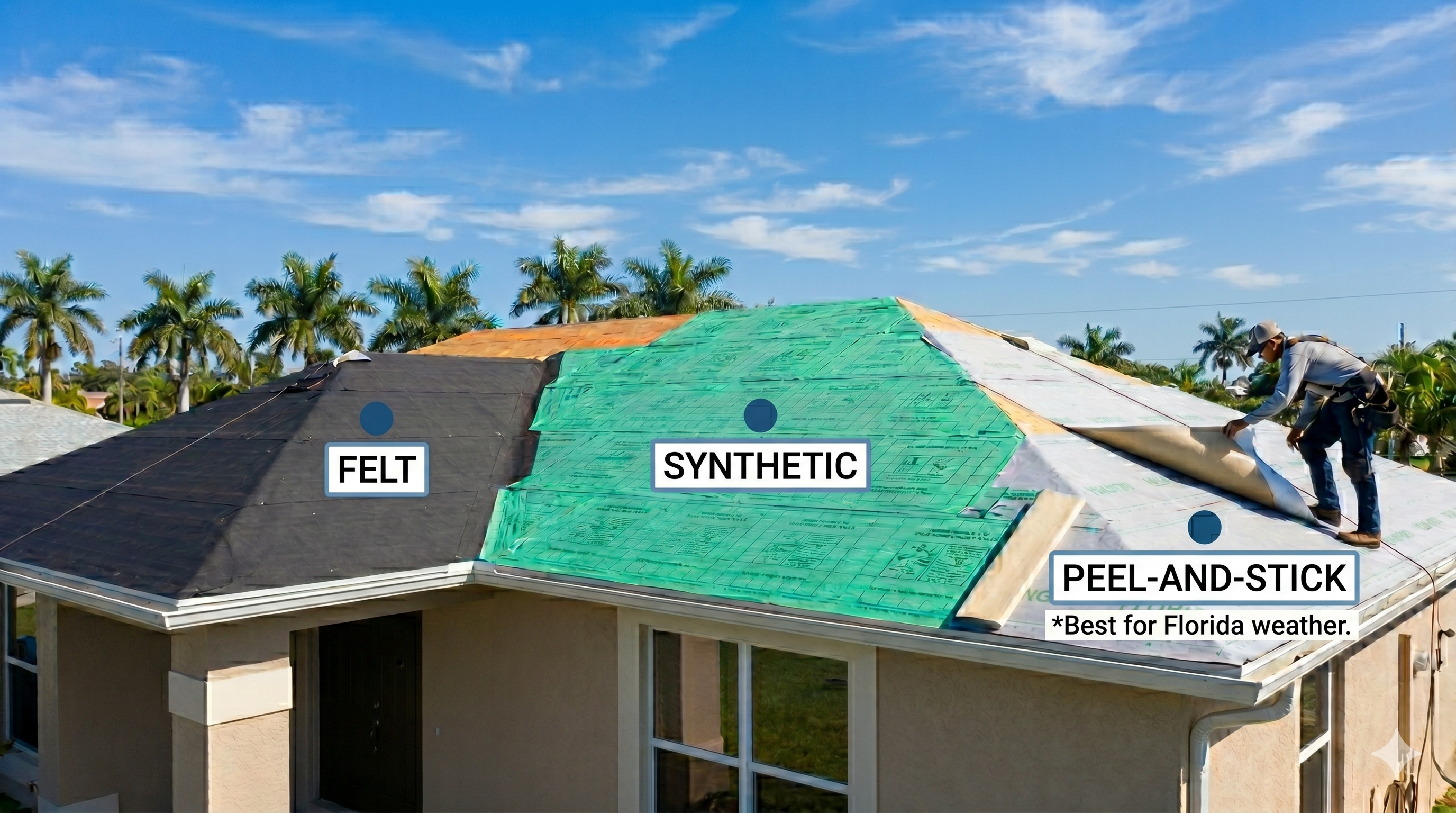
The Three Types of Roof Underlayment
Every residential roof in Florida requires at least one layer of underlayment beneath the primary roof covering. There are three main categories, and they differ significantly in performance, durability, and cost.
Asphalt-Saturated Felt (#30 Felt)
Felt underlayment — sometimes called “tar paper” — is the traditional option that’s been used for decades. It’s made from an organic or fiberglass mat saturated with asphalt, and it comes in rolls that get stapled or nailed to the deck.
Felt is inexpensive and still meets minimum Florida Building Code requirements in most areas outside the High-Velocity Hurricane Zone (HVHZ). But it has real limitations in Florida’s climate. It absorbs moisture over time, which can lead to wrinkling, mold, and deck rot underneath. It tears easily during installation and under high winds. It has very limited UV resistance — if your roof covering isn’t installed within a few days of laying the felt, sun exposure starts to degrade it. And in Florida’s attic temperatures, which routinely exceed 150°F in summer, felt can dry out and become brittle faster than in cooler climates.
Felt is still used in some budget-conscious projects, but it’s been largely replaced by synthetic options for good reason.
Synthetic Underlayment
Synthetic underlayment is made from woven or spun polypropylene — essentially a lightweight, engineered plastic sheet. It’s become the industry standard for most Florida roof replacements, and it’s what we use as the primary underlayment layer on the majority of our projects at Orange Contracting.
Synthetic outperforms felt in almost every category that matters in Florida. It doesn’t absorb water. It’s significantly more tear-resistant, which matters both during installation and during high-wind events. It lies flat without wrinkling. It offers far better UV resistance — most quality synthetic products can be left exposed for 30 to 180 days depending on the manufacturer, which provides a real safety margin if weather delays push back your shingle installation. And it provides better traction for installers on steep slopes, which is a safety issue that homeowners rarely think about but contractors deal with every day.
Synthetic costs more than felt — typically $0.25 to $0.75 per square foot compared to $0.10 to $0.25 for felt — but on a full roof replacement, the material cost difference is modest relative to the total project price and the meaningful improvement in performance.
Self-Adhering Membrane (Peel-and-Stick)
Self-adhering underlayment — commonly called “peel-and-stick” or by brand names like Grace Ice & Water Shield — is a rubberized asphalt membrane that bonds directly to the roof deck without mechanical fasteners. It creates a sealed, watertight barrier that self-seals around nail penetrations when shingles are installed over it.
This is the highest-performing underlayment option, and it’s the one that matters most for Florida homeowners from both a code and insurance perspective.
Peel-and-stick is mandatory in Florida’s High-Velocity Hurricane Zones (Miami-Dade and Broward counties), where it must meet ASTM D1970 standards. Outside the HVHZ — which includes all of Central Florida — it’s not always required by code for the entire deck, but it plays a critical role in two ways: it’s one of the methods for creating the code-required sealed roof deck (secondary water barrier), and it’s the product that qualifies you for the Secondary Water Resistance (SWR) discount on your wind mitigation inspection.
The trade-off is cost and permanence. Peel-and-stick runs $0.50 to $1.50 per square foot, and once it’s bonded to the deck, it’s extremely difficult to remove. Future roof replacements may require installing new underlayment over the existing membrane or, in some cases, replacing sections of deck. The Florida Building Code does allow an existing self-adhering membrane to remain in place during a reroof, provided deck re-nailing can be verified and a new approved underlayment is installed over it.
What Florida Building Code Actually Requires
The Florida Building Code (8th Edition, effective December 31, 2023) requires a secondary water barrier on residential reroofs. This is separate from your primary underlayment — it’s an additional layer of protection designed to keep water out if the primary roof covering is lost during a storm.
There are several ways to satisfy this requirement. The most common methods for homes outside the HVHZ include:
Full-deck peel-and-stick: A self-adhering polymer-modified bitumen membrane (ASTM D1970) applied directly to the entire roof deck. This is the most comprehensive approach and the one that earns the highest insurance credit.
Peel-and-stick tape at all deck joints: Self-adhering tape strips (minimum 4 inches wide, ASTM D1970) applied over every plywood or OSB joint on the deck, followed by a layer of #30 felt or synthetic underlayment over the entire surface. This is the most cost-effective method that still qualifies for the SWR insurance discount.
Double-layer underlayment: Two layers of #30 felt or synthetic underlayment covering the entire deck. This satisfies the code requirement for a secondary water barrier but does not qualify for the SWR insurance discount on the wind mitigation form.
The distinction between “meets code” and “qualifies for insurance discounts” is one of the most misunderstood aspects of roofing in Florida, and it’s worth understanding before you sign a roofing contract.
The Insurance Connection: Why Underlayment Affects Your Premiums
Florida requires insurance carriers to offer wind mitigation discounts to homeowners who harden their properties against storms. These discounts are verified through a wind mitigation inspection (Form OIR-B1-1802), which evaluates seven features of your home — one of which is Secondary Water Resistance.
To qualify for the SWR credit, you must have a self-adhering polymer-modified bitumen product applied directly to the roof sheathing. This can be full sheets over the entire deck or tape strips over all sheathing joints. The key detail is that the product must adhere directly to the wood — if a layer of felt is placed between the peel-and-stick and the deck, it does not qualify for the discount.
The SWR discount alone can reduce the windstorm portion of your premium meaningfully. Combined with other wind mitigation credits — roof covering age, deck attachment method, roof-to-wall connections, roof geometry, and opening protection — a well-built roof can generate significant overall insurance savings.
Starting July 1, 2026, Florida law (HB 767) requires insurance companies to notify policyholders if they offer an enhanced discount for SWR — meaning carriers can no longer quietly fail to apply credits that homeowners have earned. If you’ve replaced your roof in recent years with a self-adhering underlayment, it’s worth confirming with your agent that the SWR credit is reflected on your policy.
To claim the discount, you’ll need documentation. A contractor’s affidavit confirming the type of underlayment installed, photos from the installation showing the product on the deck before the roof covering was applied, and an updated wind mitigation inspection are typically what your insurer will require. This is one of the reasons we document every underlayment installation with photos at Orange Contracting — those images have direct financial value to our customers when their wind mitigation inspection comes due.
What to Ask Your Roofing Contractor
When you’re getting estimates for a roof replacement, the underlayment conversation is one of the most telling ways to separate knowledgeable contractors from those who are just bidding on shingles. Here are the questions that matter:
“What underlayment system are you using?” You want a specific answer — product name, ASTM rating, and whether it’s felt, synthetic, or self-adhering. If the answer is vague or the contractor doesn’t seem to know, that tells you something.
“Does your system qualify for the SWR discount on my wind mitigation inspection?” This is where the real value is. If they’re proposing a double-layer felt system, it will meet code but won’t earn you the SWR insurance credit. If they’re using peel-and-stick at the joints or full-deck, it will qualify — but only if it’s applied directly to the sheathing.
“Will you provide documentation and photos of the underlayment installation?” You’ll need proof for your wind mitigation inspector and your insurance company. A contractor who routinely documents this step is one who understands how roofing and insurance interact in Florida.
“What happens to the existing underlayment during tear-off?” If your current roof has an existing peel-and-stick membrane that’s bonded to the deck, removing it without damaging the plywood can be difficult. The contractor should explain how they plan to handle this — whether they’ll leave it in place and install new underlayment over it (which the code permits under certain conditions) or replace deck sections as needed.
The Bottom Line
In most of the country, underlayment is an afterthought. In Florida, it’s one of the most consequential decisions in a roofing project. The right underlayment protects your home when the primary roof covering fails in a storm. The wrong underlayment — or the right underlayment installed incorrectly — can leave you exposed to both water damage and higher insurance premiums.
When we build a roof at Orange Contracting, the underlayment system is part of the conversation from the first estimate. We walk homeowners through the options, explain exactly how each one affects their code compliance and insurance position, and document the installation so the value carries forward to every wind mitigation inspection for the life of the roof.
If you’re planning a roof replacement and want to understand what it will cost, start with our free Instant Estimate tool for a satellite-based price range in under a minute. When you’re ready for a detailed conversation about materials, underlayment, and how to get the most out of your new roof, contact us to schedule an inspection.
Call us at 407-205-2676 or reach out online.