
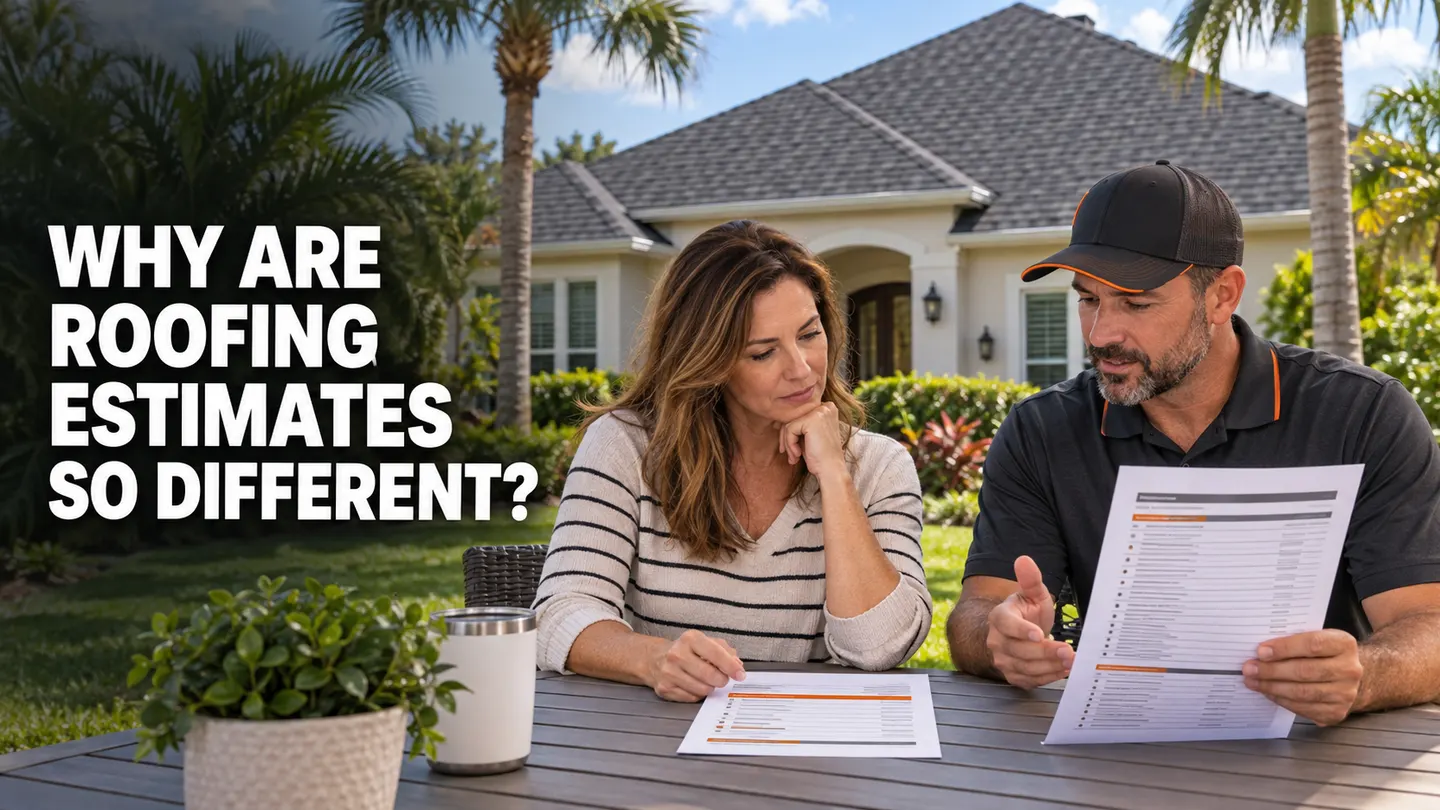
You get three estimates to replace the same roof. One is $18,000. Another is $23,000. The third is nearly $30,000.
Every contractor looked at the same house, so why aren’t the numbers even close?
The short answer is that they may not be pricing the same roof replacement. One estimate may include a more complete roofing system, a realistic allowance for damaged decking, permit costs and a meaningful workmanship warranty. Another may show little more than a shingle brand and one lump-sum price.
That does not automatically make the most expensive estimate the best one. It does mean the cheapest estimate deserves more scrutiny before you sign it.
Why can roofing estimates differ by thousands of dollars?
Roofing estimates differ because contractors may use different measurements, waste factors, materials, installation methods, labor assumptions and warranty coverage. They may also include different amounts of work.
Price matters. Scope matters first.
If one contractor includes new flashing, proper ventilation and replacement of deteriorated decking while another assumes those items will not be needed, the lower estimate is not necessarily a better price. It may be an incomplete price.
Start by comparing the scope of work
The total at the bottom of the page gets everyone’s attention. Start above it.
A roof replacement is a sequence of work. The crew has to protect the property, remove the existing roof, inspect the deck, replace damaged wood, prepare the deck, install the dry-in system, flash vulnerable areas, install the roof covering and clean up the site. A useful estimate should tell you how the contractor intends to handle those steps.
Look for details about:
- Removal and disposal of the existing roofing material
- The number of existing layers being removed
- Protection for landscaping, driveways, pools and air-conditioning equipment
- Roof-deck inspection and replacement pricing
- Deck re-nailing, when required
- Underlayment or self-adhered dry-in material
- Valley treatment
- Drip edge and other perimeter metal
- Starter shingles and ridge-cap shingles
- Pipe boots, vents, skylights, chimneys and other penetrations
- Wall and chimney flashing
- Attic ventilation
- Permit fees and required inspections
- Magnetic cleanup and removal of job debris
- Manufacturer and contractor warranties
An estimate does not need five pages of fine print to be legitimate. It should contain enough information for you to understand what is being installed and what could change the price.
Our overview of roofing services in Central Florida describes the types of roof inspections, repairs and replacements we perform. You can also review our roofing and restoration process to see what happens from the initial inspection through the final walk-through.
Measurements and waste are not always calculated the same way
Roofing contractors generally price sloped roofs by the roofing square. One square equals 100 square feet of roof area. The roof area is not the same as the home’s living area, and the amount ordered is not the same as the bare measured area.
A 2,000-square-foot house may have substantially more than 2,000 square feet of roof because of the pitch, overhangs, attached garages and other sections. The contractor also needs material for cuts, valleys, hips, ridges and starter courses.
A simple gable roof usually produces less waste than a cut-up roof with several valleys, dormers and small sections. Two contractors can start with similar measurements and still reach different material quantities because they use different waste assumptions.
Ask each contractor for the measured roof area and the total quantity being priced. If the difference is large, ask why. A contractor should be able to explain the number without treating the measurement report like a state secret.
“Architectural shingles” is not a complete material specification
Two proposals may both promise architectural shingles and still include different products.
The manufacturer, product line, color, wind-rating requirements and accessory components can all affect cost. The same is true for tile and metal roofs. A metal panel’s profile, gauge, coating and fastening system matter. A tile proposal should identify the tile and attachment method rather than saying only “concrete tile.”
The rest of the roofing system matters too. Underlayment, starter shingles, ridge caps, fasteners, flashing and ventilation are not background details. They work together. A proposal that names only the visible roof covering leaves most of the system unidentified.
Ask whether the estimate uses manufacturer-approved accessories and what must be installed for the stated warranty. If the proposal advertises an enhanced manufacturer warranty, ask who registers it and what documentation you will receive after completion.
Underlayment can create a meaningful price difference
Once the old roof covering is removed, the dry-in system protects the roof deck below the shingles, tile or metal. Contractors may propose synthetic underlayment, self-adhered membrane or a combination of materials depending on the roof system and applicable requirements.
These products do not cost the same, and they do not perform the same job in the same way. The estimate should identify the proposed underlayment rather than use a vague phrase such as “code-approved dry-in.”
This is also one reason a roof-over can appear cheaper. Leaving the old shingles in place avoids tear-off work, but it limits the contractor’s ability to inspect the deck and install a new system directly over it. We explain the problems in more detail in Can I Reroof Over Existing Shingles in Florida?.
Decking allowances can turn a low estimate into an expensive job
No contractor can confirm the condition of every sheet of plywood or OSB while the roof covering is still in place. Some damaged areas can be identified from the attic or by walking the roof, but concealed deterioration may not appear until tear-off.
The uncertainty is real. The way it is handled should not be a surprise.
Check whether the estimate includes:
- Any amount of decking replacement in the base price
- A price per sheet or per square foot for additional decking
- Labor, materials and disposal in that unit price
- A requirement for your authorization before substantial additional work begins
- Photographs or other documentation of the damaged areas
A low proposal with no stated wood price can become much less attractive once the roof is open. A clear unit price lets you compare the risk before the project starts.
Flashing, ventilation and penetrations are common sources of differences
Shingles get most of the attention because they cover most of the roof. Leaks often begin at the interruptions: walls, valleys, skylights, plumbing vents, exhaust vents and chimneys.
One contractor may price replacement of aging pipe boots and flashing. Another may plan to reuse what is already there. One may calculate the ventilation the roof needs. Another may replace the existing vents in the same locations without determining whether the system is balanced.
Reusing a component is not always wrong. It should be an intentional decision based on its condition and compatibility with the new roof, not an assumption buried inside the lowest bid.
The company behind the estimate affects the price
Homeowners are buying more than materials and installation labor. They are hiring a company to coordinate the project, pull the permit, supervise the work, communicate about changes and return if there is a warranty problem.
That company may carry different levels of liability insurance, workers’ compensation coverage and overhead. It may use experienced project managers or leave most decisions to the crew. It may have a local office and a service department, or it may be difficult to locate six months later.
Before signing, verify the contractor’s license through the Florida Department of Business and Professional Regulation. Confirm that the name on the license matches the company on the contract. Ask for current insurance information and find out who is responsible for supervising your project.
Florida also places specific requirements and restrictions on residential roofing contracts and insurance-related solicitations. The Florida Department of Financial Services publishes a useful contractor and residential property FAQ for homeowners.
A warranty is only as useful as the coverage behind it
“Lifetime warranty” sounds impressive. By itself, it tells you very little.
There are usually two separate warranty questions:
- What does the manufacturer cover if the roofing product is defective?
- What does the contractor cover if the installation causes a problem?
Read the workmanship term, exclusions and transfer provisions. Ask whether the contractor’s warranty covers both labor and materials needed to correct defective installation. Find out how a service request is submitted and how the company documents completion.
A long manufacturer warranty does not replace a contractor workmanship warranty. Manufacturers generally do not take responsibility for every installation error, and the contractor cannot rewrite the manufacturer’s coverage.
Is the cheapest roofing estimate ever the right choice?
Yes. A lower estimate can be the right choice when the scopes are genuinely comparable and the contractor is properly licensed, insured and capable of standing behind the work.
The mistake is assuming that three totals represent three prices for the same product.
If the least expensive contractor measured the roof correctly, identified the materials, included the required components, stated the decking price, explained the warranty and answered your questions clearly, there may be no reason to pay more.
If the low estimate depends on vague allowances, reused components or items that will be priced later, you do not yet know whether it is cheaper.
The same caution applies to the highest estimate. A larger number does not prove that the work is better. The contractor should be able to show what you are receiving for the difference.
How to compare roofing estimates side by side
Use the same questions for every proposal:
| What to compare | What the estimate should tell you |
|---|---|
| Roof quantity | Measured roof area and total material quantity |
| Tear-off | Material and number of existing layers being removed |
| Roof deck | Included allowance and unit price for additional wood |
| Dry-in | Product type, manufacturer or specific system |
| Roof covering | Manufacturer, product line, profile and color selection |
| Accessories | Starter, ridge, valleys, flashing, vents and pipe boots |
| Permit | Whether permit and inspection fees are included |
| Protection and cleanup | Property protection, debris removal and magnetic sweep |
| Changes | How change orders are documented and approved |
| Warranty | Manufacturer coverage and contractor workmanship term |
| Contractor | License, insurance, supervision and local service contact |
| Payment | Deposit, progress-payment schedule and final-payment conditions |
Do not hesitate to ask one contractor about an item that appears in another contractor’s estimate. A professional should be willing to explain whether the item is included, unnecessary or being handled differently.
Red flags in a roofing estimate
Be cautious when:
- The proposal contains only a total price and a shingle color
- The contractor will not identify the actual product line
- Decking replacement has no unit price
- Permit costs are excluded without explanation
- Large deposits are requested without a clear payment schedule
- Verbal promises do not appear in the written agreement
- The contractor pressures you to sign before you can compare the scope
- Someone offers to waive or absorb an insurance deductible
- The company name on the proposal does not match the license or insurance documents
- The warranty sounds broad but is not provided in writing
Florida prohibits contractors from offering to waive an insurance deductible or provide something of value in exchange for allowing a roof inspection or filing a claim. That is not a clever discount. It is a reason to slow down and verify who you are dealing with.
Frequently asked questions about roofing estimates
How many roofing estimates should I get?
Two or three detailed estimates are usually enough to compare the proposed scope, materials and contractor. Collecting more proposals does not help if none of them contain enough detail to make a meaningful comparison.
Should every roofing estimate be the same price?
No. Contractors have different labor costs, suppliers, overhead, warranty programs and methods. The prices should make more sense once you compare the quantities and scope line by line.
Why did my roofing estimate increase after tear-off?
Concealed deck damage may not be visible until the old roofing materials are removed. The original estimate should explain how additional decking or structural work will be priced, documented and approved.
Does a higher roofing estimate mean better quality?
Not necessarily. Higher-quality materials, a more complete scope and stronger project supervision can cost more, but price alone does not establish quality. Ask the contractor to explain the specific differences.
What should a roof replacement estimate include?
A roof replacement estimate should identify the roof quantity, tear-off, deck work, underlayment, roof covering, accessories, flashing, ventilation, permit, cleanup, payment terms and warranties. It should also explain how unforeseen work will be handled.
Compare the roof, not only the number
You do not need to become a roofer to choose a roofing contractor. You do need enough information to confirm that the estimates cover the same basic work.
If you are planning a roof replacement in Central Florida, you can start with our free instant roof estimate. It provides a preliminary range using satellite measurements of your property. For a firm proposal, contact Orange Contracting and Roofing to schedule an inspection and receive a written scope based on your roof.
You can also review our Central Florida project gallery to see completed shingle, tile and storm-restoration projects.
Orange Contracting and Roofing serves homeowners and businesses throughout Central Florida. Florida roofing contractor license: CCC1337502. Call 407-205-2676 to discuss your roof or request an inspection.