
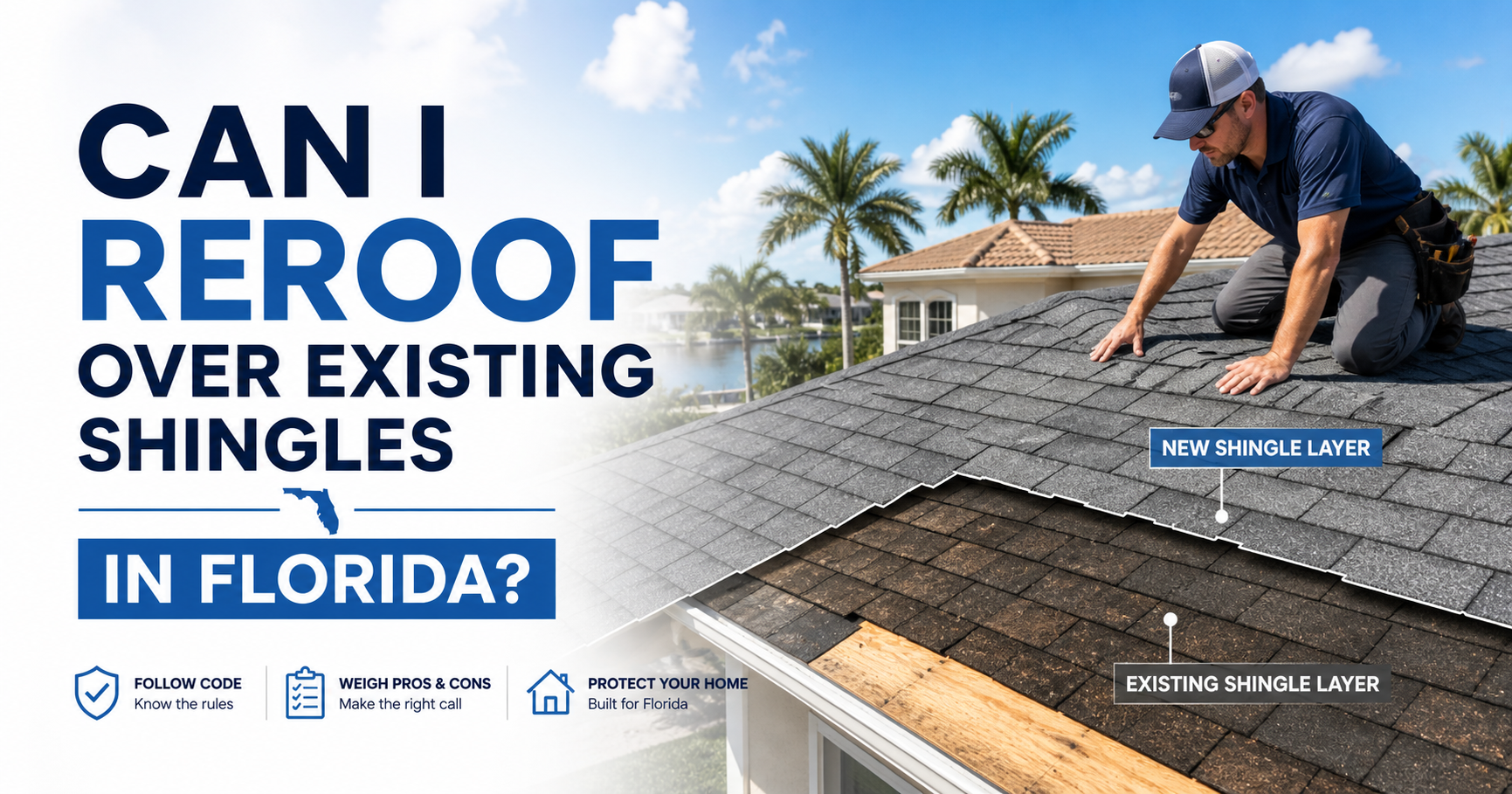
It’s one of the most common questions we hear from homeowners looking to save money on a reroof: “Can you just shingle over what’s already there?”
The short answer is: in very limited situations, Florida allows it. The longer answer — and the one that actually matters — is that doing so almost always creates more problems than it solves, and in Florida’s climate, those problems tend to be expensive.
Here’s what the code says, what it doesn’t say, and what we’ve seen firsthand when we tear off a roof that was previously shingled over.
What Florida Building Code Says About Roof-Overs
The Florida Building Code permits a maximum of two layers of asphalt shingles on a residential roof. That means if your home currently has one layer, a contractor can technically install a second layer over it — a process called a “roof recover” or “overlay.”
However, the code also lists several conditions where a roof-over is explicitly prohibited. You cannot install new shingles over existing shingles when:
- The existing roof covering is water-soaked or deteriorated to the point that it can’t serve as a proper base for additional roofing
- The existing roof has blisters that haven’t been cut open, flattened, and secured
- The roof sheathing or structural supports are deteriorated and no longer structurally adequate
- The home already has two or more layers of roofing material
That last point is absolute — if there are already two layers on the roof, everything comes off down to the deck before a new roof can go on.
Even when a roof-over is technically permitted, it still requires a building permit and inspections. Any contractor who suggests otherwise is cutting corners in ways that will create problems for you down the road — with your insurance, your home’s resale value, and potentially your safety.
Why a Roof-Over Sounds Good on Paper
The appeal is obvious. A roof-over eliminates the labor and disposal cost of tearing off the old shingles. No tear-off means a faster job — sometimes a full day shorter. And because there’s less labor and no dumpster rental, the upfront price is lower.
For a homeowner watching their budget, saving $2,000 to $4,000 on a reroof is compelling. But that savings is almost always an illusion, because it comes at the cost of things you can’t see until it’s too late.
What a Roof-Over Actually Hides
When a contractor installs new shingles over old ones, they skip the most important quality-control step in the entire roofing process: inspecting the deck.
The roof deck — the plywood or OSB sheathing that everything sits on — is the structural foundation of your roof system. In Central Florida, where heat, humidity, and afternoon storms are constants, deck damage is common. Slow leaks from worn flashing, failed pipe boots, or cracked shingles let moisture reach the wood. Over time, that moisture causes delamination, soft spots, and rot. From above, with shingles still in place, a damaged deck can look and feel perfectly solid. It’s only when the old shingles come off and someone walks the deck or probes suspect areas that the real condition reveals itself.
A roof-over buries all of that. The new shingles go on, the roof looks great, and the homeowner has no idea that the wood underneath is compromised — until the next storm drives rain into those same soft spots, or until the deck fails altogether.
What We Found Under a Recent Roof-Over in Central Florida
We recently completed a full tear-off and reroof on a home in Central Florida where the previous contractor had shingled over the original roof. The homeowner came to us because the roof was leaking again despite being “replaced” only a few years prior.
When our crew stripped the top layer of shingles, we found the original layer still underneath — brittle, curled, and in some areas completely deteriorated. That alone wasn’t the worst of it.
Once we pulled both layers off and exposed the deck, nearly half of the plywood needed to be replaced. Large sections were delaminated — the layers of the plywood had separated and lost their structural integrity. Other areas were soft and spongy from years of moisture intrusion that the original roof-over had never addressed. Several sheets were dark with mold growth on the underside. Around penetrations — pipe boots, exhaust vents, and a skylight — the damage was especially severe, because those are the areas where leaks are most likely and where proper flashing work is most critical.
None of this was visible from the outside. None of it was visible from the attic. It was only visible once the old roofing material was completely removed, which is exactly the step the roof-over had skipped.
The homeowner ended up paying for a full tear-off of two layers of shingles — twice the disposal cost of a normal reroof — plus the replacement of roughly half the deck in new plywood, re-nailed to code. The total project cost significantly more than a proper tear-off and reroof would have cost in the first place. And the “savings” from that original roof-over? Gone. Every dollar of it.
This isn’t an unusual story. We see some version of it multiple times a year. The roof-over appears to save money initially, but it defers and compounds the real problem underneath.
Other Reasons a Roof-Over Is a Bad Idea in Florida
Beyond the hidden deck issue, there are several practical reasons why roof-overs are particularly poor choices in Florida.
Added weight. A second layer of asphalt shingles adds roughly 2 to 3 pounds per square foot of dead load to your roof structure. On a 2,000-square-foot roof, that’s 4,000 to 6,000 additional pounds sitting on your trusses. Florida homes are engineered for specific load ratings that account for wind uplift, rain accumulation, and the weight of one roof system — not two. Adding a second layer reduces the structural margin your trusses have for handling storm loads.
Reduced shingle lifespan. Shingles installed over an existing layer don’t last as long. The old layer traps heat, and in Florida’s summer, attic temperatures already push 150°F or higher. That extra heat accelerates the aging of the new shingles, causing granule loss, curling, and brittleness sooner than they would on a clean deck with proper ventilation. Most manufacturer warranties are also reduced or voided entirely when shingles are installed as a second layer.
No sealed roof deck. Florida Building Code requires a secondary water barrier (sealed roof deck) on residential reroofs. This is a self-adhering membrane or tape applied directly to the roof sheathing to protect against water intrusion when the primary roof covering is lost in a storm. You can’t install a sealed roof deck over existing shingles — it has to bond to the wood. A roof-over eliminates the possibility of this critical protection layer and disqualifies you from the Secondary Water Resistance (SWR) insurance discount on your wind mitigation inspection.
Insurance complications. Many Florida insurance carriers now ask specifically whether the roof has been overlaid. Some will decline to insure a two-layer roof, or will impose a higher deductible. If you file a claim on a roof that was shingled over and the adjuster discovers underlying deck damage that was never addressed, the carrier has legitimate grounds to dispute the claim. Your roof directly affects your insurability in Florida — installing a second layer makes that equation worse, not better.
Inspection limitations. When a building inspector inspects a roof-over, they’re evaluating the new shingles on top of old shingles. They can check nailing patterns and flashing details on the surface layer, but they can’t verify the condition of the deck, the attachment of the sheathing to the trusses, or the presence of a secondary water barrier. The inspection is inherently limited, and so is the protection it provides.
When Is a Tear-Off Required?
Florida code requires a full tear-off (down to the deck) in any of these situations:
- The home already has two layers of roofing
- The existing roof covering is deteriorated, water-soaked, or blistered
- The roof sheathing is damaged or structurally compromised
- The homeowner wants to install a sealed roof deck and qualify for the SWR insurance discount
- The reroof triggers the 25% rule on a pre-2007 code roof
In practice, a full tear-off is the right call in almost every situation. It’s the only way to verify the deck, replace damaged wood, install a proper underlayment system, and build a roof that will actually perform for its full rated lifespan.
What a Proper Reroof Looks Like
A full tear-off and reroof follows a clear sequence: strip the old shingles and underlayment down to bare deck, inspect every sheet of plywood or OSB, replace any damaged sections, re-nail the deck to current Florida Building Code specifications, install a sealed roof deck (self-adhering membrane or tape at all deck joints), install synthetic underlayment, then install the new roof covering with proper flashing, ventilation, and edge details.
We walk through this entire process in detail in our post on what to expect during a roof replacement. It’s a longer process than a roof-over, and yes, it costs more upfront. But it’s the only way to build a roof that’s genuinely solid from the deck up — and in Florida, that’s what your home needs.
The Bottom Line
Can you reroof over existing shingles in Florida? Technically, in limited circumstances, yes. Should you? Almost never.
The money you save on a roof-over gets spent — and then some — when the hidden damage underneath finally makes itself known. And in Central Florida, where every roof is tested by UV, rain, and wind on a daily basis, it always makes itself known eventually.
At Orange Contracting and Roofing, we don’t do roof-overs. Every reroof we perform is a full tear-off with a complete deck inspection, because we’ve seen too many times what happens when that step gets skipped. We’re licensed general contractors, licensed roofing contractors (CCC1337502), and a licensed residential contractor (CRC1336049), and we believe the only roof worth installing is one built on a foundation you’ve actually verified.
If you want to know what a new roof would cost for your home, start with our free Instant Estimate tool — satellite-based pricing in under a minute, no appointment needed. When you’re ready for a professional inspection, get in touch.
Call us at 407-205-2676 or schedule a consultation online.