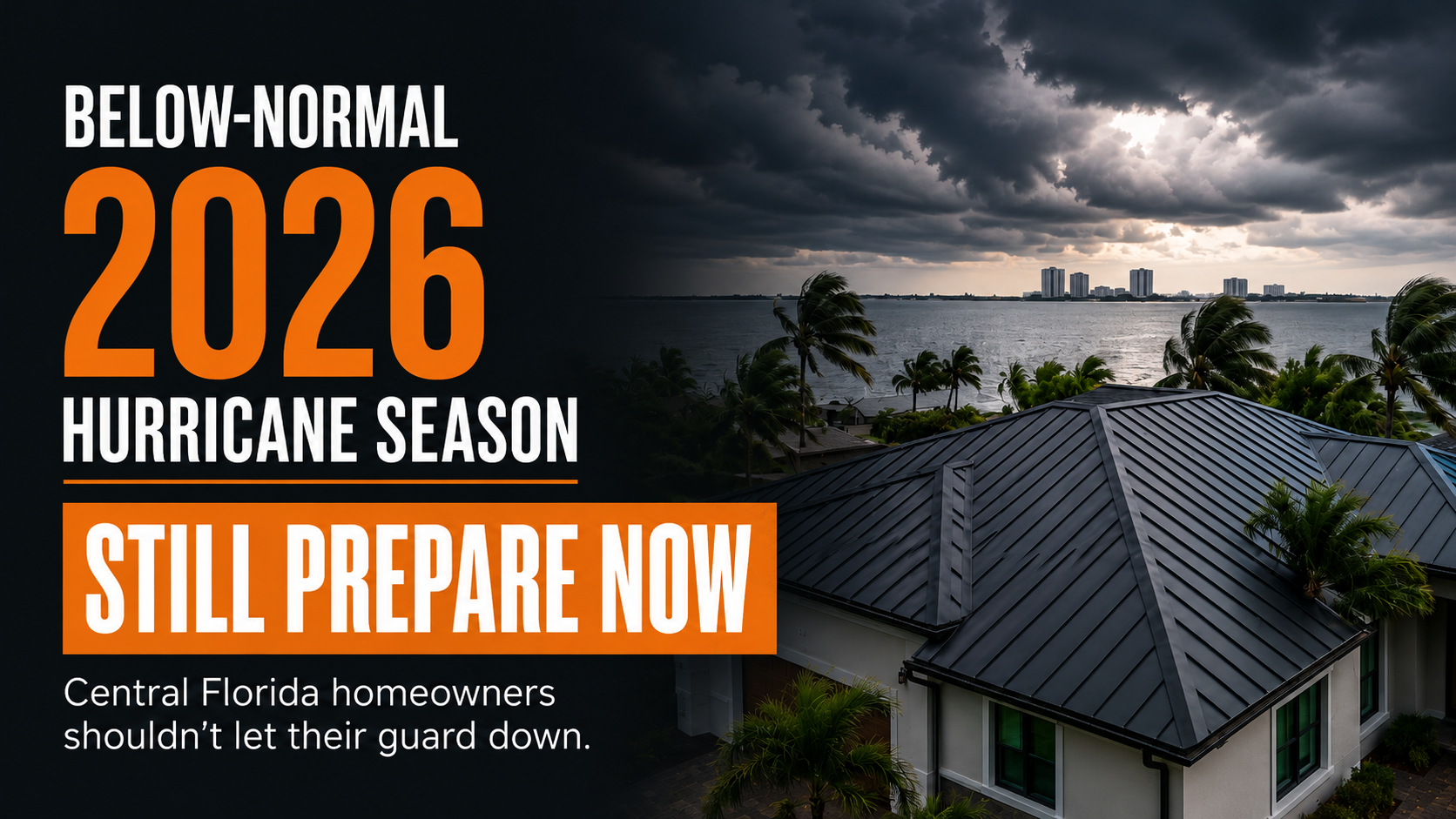
If you’ve caught any of the headlines this spring, you already know the storyline: 2026 is supposed to be a quiet hurricane season. NOAA’s official outlook calls for below-normal activity, and that’s the version most homeowners will remember when they decide whether to bother prepping this year.
Here’s the problem. “Below normal” describes how many storms might form across the entire Atlantic basin over six months. It says nothing about whether one of them hits Central Florida. And a single landfall is all it takes to put a tree through your roof, strip your shingles, or drive water into your attic.
We’ve been on both sides of that storm — as licensed roofing contractors who repair the damage, and as licensed public adjusters who fight the insurance claim afterward. So let’s separate what the forecast actually says from what it doesn’t, and talk about what’s worth doing right now.
What did NOAA forecast for the 2026 hurricane season?
In its May outlook, NOAA predicted a below-normal 2026 Atlantic hurricane season, with a 55% chance the season finishes below average. The specific numbers:
- 8 to 14 named storms (winds of 39 mph or higher)
- 3 to 6 hurricanes (winds of 74 mph or higher)
- 1 to 3 major hurricanes (Category 3 or stronger)
For comparison, an average season produces 14 named storms, 7 hurricanes, and 3 major hurricanes. So the 2026 forecast lands at or below average across the board. NOAA updates the outlook in early August, ahead of the historical September-October peak.
Why is 2026 expected to be quieter?
The main driver is an expected El Niño. When El Niño develops in the Pacific, it tends to increase wind shear over the Atlantic — and strong shear tears apart developing storms before they can organize. Forecasters put the odds of El Niño arriving by July at better than 80%, which is why nearly every major outlook this year, including NOAA’s, leans below normal.
That’s real, and it’s good news on balance. But notice what the forecast is measuring: the number of storms, basin-wide. It is explicitly not a landfall forecast, and NOAA says so directly every year.
Why “below normal” is the dangerous part
A quiet season lowers the odds that a storm forms. It does almost nothing to change what happens to your house if one does. Two facts make this clear:
1992 was a below-normal season. That year produced only seven named storms — a quiet count by any measure. One of them was Hurricane Andrew, a Category 5 that flattened Homestead and remains one of the most destructive hurricanes in U.S. history. The seasonal number told South Florida nothing about the August it was about to have.
2023 was an El Niño year too — and it still generated 20 named storms because Atlantic water temperatures ran unusually warm. El Niño suppresses activity; it doesn’t switch it off. Forecasts are probabilities, not guarantees.
And 2026 is not theoretical yet. By mid-June, the National Hurricane Center was already issuing advisories on the season’s first potential tropical cyclone in the Gulf — two weeks into a season that’s supposed to be slow. The tropics don’t read the outlook.
A quiet forecast doesn’t lower your risk
Central Florida’s exposure isn’t driven by the named-storm count. It’s driven by where we sit. Inland counties still take damaging wind, and storms that weaken to tropical-storm strength after landfall can sit over the Orlando metro for hours, dumping rain and pushing water into roofs that were already near the end of their service life.
If your roof is 12, 15, or 20 years old, the question that matters isn’t “how many storms will there be?” It’s “will my roof hold up to the one that comes?” That’s a condition question, and it has nothing to do with the forecast.
What Central Florida homeowners should do now
Use the early-season lull while it lasts. Here’s the short list, in priority order.
1. Document your roof and property before anything happens. This is the single most valuable thing you can do, and almost nobody does it. Walk your property and take dated photos and video of your roof, soffits, fascia, windows, and interior ceilings while everything is intact. If you later file a claim, this is the evidence that proves the damage was caused by the storm — not pre-existing wear the carrier can deny. More on why this matters below.
2. Get a real assessment of your roof’s condition. Age alone doesn’t tell you much; condition does. If you’re not sure where your roof stands, start with our free roof lifespan calculator for a quick read, then schedule a professional inspection if it raises flags.
3. Strengthen what you can. A new or properly upgraded roof isn’t just protection — it generates insurance savings. Replacing a roof to current code can qualify you for wind mitigation credits, and adding a sealed roof deck earns the secondary-water-resistance credit. If you qualify, the My Safe Florida Home program can cover a large share of those hardening costs.
4. Read your policy before you need it. Know your hurricane deductible (it’s a percentage of your dwelling coverage, not a flat dollar amount), and confirm whether your roof is covered at replacement cost or actual cash value. The difference can be tens of thousands of dollars after a total loss. A current, well-maintained roof also protects you from age-based non-renewal.
5. Build your kit and plan. Ready.gov and the Florida Division of Emergency Management both have straightforward checklists for supplies, evacuation routes, and family communication plans.
Why pre-storm documentation matters for your claim
This is where our background changes the advice we give. We’ve worked carrier-side as staff adjusters, we adjust claims now as licensed public adjusters, and we do the construction. From that vantage point, the single biggest reason good claims get underpaid or denied is the carrier arguing the damage was already there.
When you file after a storm, the burden is effectively on you to show the loss was sudden and storm-caused. If your only “before” picture is a satellite image from three years ago, you’re negotiating from weakness. If you have dated, detailed photos from June showing an intact roof, the conversation changes entirely. Pre-storm documentation is the cheapest insurance you’ll ever buy, and the lull before peak season is exactly when to create it.
If a storm does hit, we can handle the claim for you directly — reading your policy, documenting the loss, and dealing with the carrier on your behalf. And if your situation gets complicated, like a denial, an underpayment, or a dispute over what actually caused the damage, our sister company NeJame Claims can step in as your dedicated public adjuster to take it the rest of the way.
How Orange Contracting can help
Most roofing companies can put a roof on. Very few can also tell you how that roof affects your insurability, your premium credits, and your claim if it’s damaged — because they’ve never sat on the carrier side or adjusted a claim. We have. That combination is why homeowners call us before the storm, not just after.
Whether you want a straight condition inspection, a hardening plan that earns insurance credits, or a full replacement before peak season, we can scope it accurately and document it properly from day one.
Don’t wait for the August forecast update. Get a fast, no-obligation Instant Estimate on your roof, or call us at 407-205-2676 to schedule an inspection. You can also reach us through our contact page.
Orange Contracting and Roofing is a licensed roofing and residential contractor (CRC1336049 / CCC1337502) serving Central Florida, with licensed public adjusters and Xactimate-certified estimators on staff. We help homeowners protect their roofs before the storm and recover fairly after one.